A weak wire rope termination can turn a reliable rig into a maintenance problem. Wrong clip size, poor thimble matching, corrosion, or unsuitable fittings can reduce service life and create avoidable risk. The solution starts with choosing compatible wire ropes, wire rope clips, thimbles, and swivels as one system.
Wire rope clips, thimbles, and swivels help create secure and durable wire rope connections. A wire rope clip holds a loop or termination, a wire rope thimble protects the eye from wear and deformation, and a swivel allows controlled rotation between connected parts. Correct material, rope diameter, clip size, installation, and application determine the strength and service life of the final assembly.
What Are Wire Rope Clips, Thimbles, and Swivels?
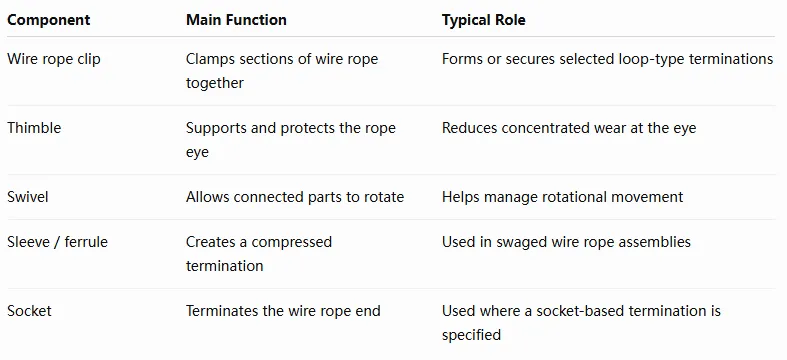
Wire ropes rarely work alone. A useful rigging system normally needs connection hardware at one or both ends. A termination may form an eye, connect the rope to a shackle, attach it to another fitting, or allow movement between two rigging components.
Three common parts are the wire rope clip, thimble, and swivel. Each has a different job.
A clip and thimble combination is common where an eye loop needs both clamping and protection. A thimble sits inside the wire rope eye, while the clips secure the turned-back rope according to the specified installation method.
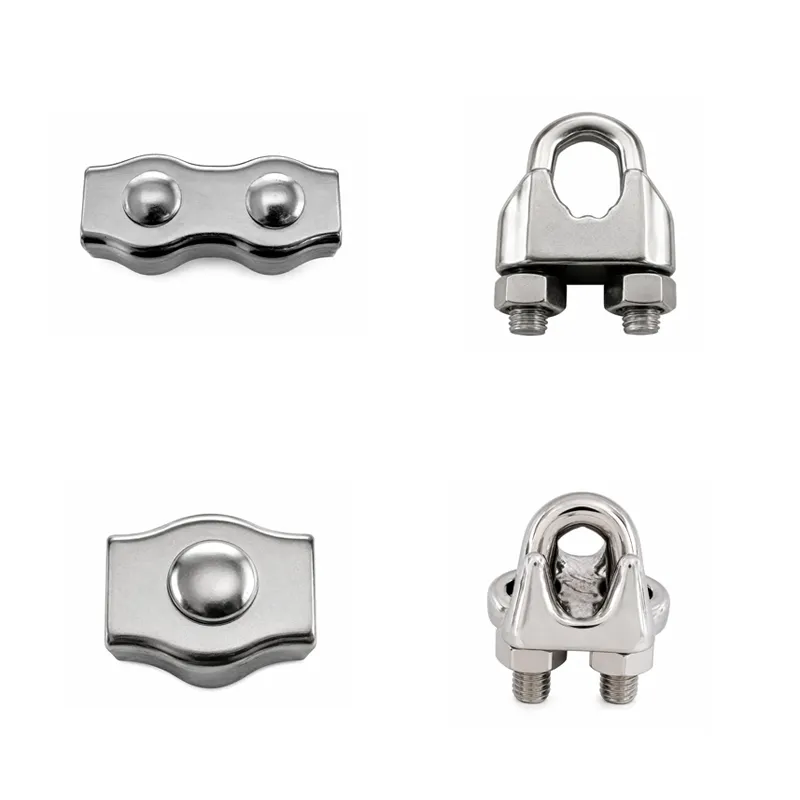
HIGRACE’s product catalog includes simplex clips, duplex clips, DIN 741 wire rope clips, US-type clips, several thimble configurations, and eye-eye, eye-jaw, and jaw-jaw swivels. Depending on the model, the range includes AISI 316 stainless steel and galvanized steel options.
Buyers building a broader marine range can also match these products with HIGRACE shackles and marine connection hardware.
How Does a Wire Rope Clip Secure Wire Ropes?
A wire rope clip provides a mechanical method of clamping two parallel sections of rope together. In a common eye termination, the rope turns around a thimble, and the dead end runs back alongside the live part of the rope.
The clip then applies clamping force between these two rope sections.
For a U-bolt clip, the main parts are:
U-bolt
Saddle
Nuts
Rope contact surfaces
The live part carries the main load. The dead end is the short turned-back portion. Clip orientation matters because placing the components incorrectly can damage the loaded side of the rope or produce an incorrect termination.
OSHA specifies that where U-bolt wire rope clipsare used to form eyes in covered construction applications, the U-bolt section contacts the dead end. Crosby’s application instructions likewise place the live rope in the saddle and require the specified clip quantity, spacing, turnback, and recommended torque for that particular rope and clip size.
This is why buyers should never choose the number of clips from appearance alone. Rope diameter, clip design, manufacturer data, and application all matter.
A distributor sourcing different clip formats can review HIGRACE’s Clips, Thimbles & Swivels product category for related wire rope fittings.
Why Is a Wire Rope Thimble Important in a Wire Rope Eye?
When wire ropes form an eye directly around a pin, shackle, hook, or other small-radius fitting, repeated contact can concentrate pressure on the rope.
A thimble creates a shaped bearing surface inside that eye.
Its purpose is simple: support the loop and reduce direct wear and deformation of the wire rope eye.
A typical wire rope thimble should be selected according to the rope diameter and the connection geometry. If it is too small, the rope may not seat correctly. If it is too large, the eye and mating fitting may not match properly.
Common variations include:
Standard thimble
DIN 6899 thimble
Light-duty US-style thimble
Heavy-duty thimble
Tube thimble
Stainless steel thimbles
Galvanized thimbles
HIGRACE’s catalog includes tube thimbles in AISI 316 stainless steel, hot-dip galvanized steel, and painted steel depending on the model, together with several other thimble styles.
For marine buyers, a properly matched thimble eye also creates a cleaner interface with a shackle or other rigging component.
What Role Does a Swivel Play in a Wire Rope Rig?
A swivel addresses a different problem: rotation.
During operation, a cable or rope system can experience twisting caused by movement, changing load direction, connected equipment, or vessel motion. Where a swivel is appropriate for the design, it provides rotational freedom between two connected sections.
HIGRACE supplies several AISI 316 stainless steel swivel configurations, including:
Swivel eye-eye
Swivel eye-jaw
Swivel jaw-jaw
Its catalog lists these products across multiple sizes and provides breaking-load data for the specific models shown.
The connection style matters. An eye-eye configuration works differently from an eye-jaw fitting because the mating hardware is different. Buyers should check pin size, eye dimensions, rope system geometry, and expected load.
A swivel is also not a cure for every twisting problem. The whole rigging setup should be evaluated. In some applications, rope construction itself affects rotational behavior.
When your system includes blocks or rope direction changes, HIGRACE’s marine blocks and pulleys can be sourced alongside other rigging components.
Which Materials Work Best for Marine Wire Rope Hardware?
Marine hardware faces salt, moisture, spray, temperature change, and repeated mechanical contact. Material selection therefore affects both corrosion resistance and maintenance.
HIGRACE offers AISI 316 stainless steel across many of its marine clips, thimbles, and swivels. Its catalog also includes electro-galvanized and hot-dip galvanized steel options for selected products.
AISI 316 stainless steel
316 stainless steel is widely selected for marine hardware because of its resistance to corrosive marine environments. It is particularly relevant where appearance, corrosion performance, and low-maintenance surfaces matter.
Electro-galvanized steel
Electro-galvanized components use a zinc coating that helps prevent corrosion. This finish is available on selected HIGRACE wire rope clips.
Hot-dip galvanized steel
Hot-dip galvanized hardware generally receives a thicker zinc coating than typical electro-galvanized hardware. HIGRACE offers hot-dip galvanized options on selected thimbles and other rigging products.
The correct choice depends on more than the environment. Buyers should consider compatibility with the remaining rig, target service life, cost, maintenance, and the exact application.
Do not assume every wire rope fitting is available in every material. Always confirm the individual model specification.
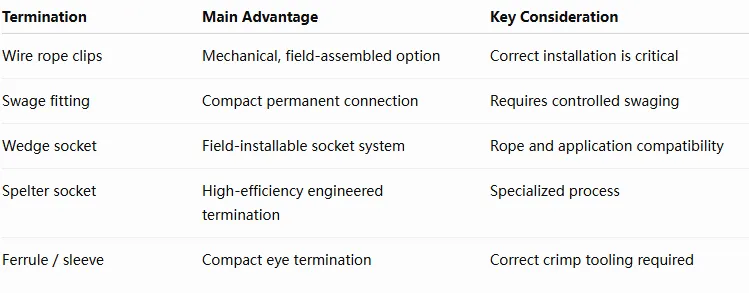
Wire Rope Clips, Swage Fittings, or Wedge Sockets: Which Termination Is Better?
There is no single best termination for all wire ropes.
Clips allow selected mechanical terminations to be assembled without permanent swaging. They can be useful where the relevant design, manufacturer instructions, and regulations permit their use.
Swage fittings
A swage termination uses controlled deformation to secure a terminal or sleeve to the rope. Swaging can produce compact, professional wire rope assemblies, but it requires the correct dies, equipment, process control, and compatible components.
HIGRACE’s rigging range includes swage stud terminals, eye swage terminals, jaw swage terminals, aluminum and copper sleeves, and crimping tools.
Wedge sockets
Wedge sockets use a wedge and socket body to capture the rope. They are common in certain industrial rope systems, but suitability depends strongly on rope construction and application.
Other sockets
Other termination methods include spelter sockets and specialized socket systems.
The choice should come from system design—not simply cost.
For B2B buyers building wire rope assemblies, it is useful to source rope hardware, terminals, sleeves, clips, and connection components from suppliers that can help with product matching.
How Do Inspection and Maintenance Extend Wire Rope Service Life?
Even a correctly installed system changes during service.
Wire ropes bend. Fittings move. Salt deposits build up. Surfaces wear. Nuts can require checking where the manufacturer specifies it.
Regular visual inspection should look for:
Broken wires
Severe corrosion
Abrasion
Crushing
Kinks
Wear near the termination
Thimble movement
Loose hardware
Cracked or distorted fittings
Wear and deformation
Damage around eye loops
OSHA requires inspection of wire rope slings in covered applications and removal from service when damage or defects make them unsuitable; its maritime rules also specifically call attention to corrosion, excessive wear, and sections near terminal connections.
A thimble itself should also be checked. A bent or damaged thimble may no longer support the eye correctly.
In a marine rig, washing away salt deposits and monitoring early corrosion can support more reliable operation. Material choice helps, but stainless steel is not a substitute for inspection.
Good maintenance protects rope service life and helps preserve long-lasting connections.
What Should B2B Buyers Look for in a Wire Rope Fittings Supplier?
A distributor buying one wire rope clip can compare prices. A professional sourcing program needs more.
If your catalog includes wire ropes, clips, thimbles, swivels, shackles, terminals, blocks, and other rigging hardware, product compatibility becomes a major buying issue.
Ask prospective suppliers about:
Product size range
Material specifications
AISI 316 options
Galvanized products
Dimensional documentation
Breaking-load or working-load data where applicable
QC procedures
Material testing
OEM manufacturing
Drawing-based development
Sample-based customization
Packaging and private-label support
HIGRACE Hardware Limited has focused on rigging hardware and precision stainless steel investment casting since 2006. The company supplies marine and industrial hardware to distributors, wholesalers, boat builders, and other international customers, while supporting engineering, quality control, and customized development.
Our catalog places shackles, clips, swivels, thimbles, and blocks within one connected product group, while additional ranges cover rigging screws, terminals, turnbuckles, chains, anchors, deck fittings, and other marine products.
That breadth matters when buyers want fewer suppliers and better product matching.
Explore our broader Rigging & Sail Control solutions to see how these components fit into a complete marine rigging system.
Why Source Clips, Thimbles & Swivels from HIGRACE?
We approach these components as part of a system rather than isolated pieces.
For the Clips, Thimbles & Swivels category, HIGRACE’s existing product range includes:
Simplex clips
Duplex clips
DIN 741 wire rope clips
US-type wire rope clips
Standard thimbles
Tube thimbles
Eye-eye swivels
Eye-jaw swivels
Jaw-jaw swivels
The catalog confirms AISI 316 stainless steel across many of these products, with electro-galvanized, hot-dip galvanized, or painted alternatives on selected models.
Beyond catalog supply, HIGRACE provides OEM and custom manufacturing based on drawings and samples. Our engineering team supports product development, while our QC capability can include material composition analysis, mechanical property testing, and tensile testing.
For distributors and private-label customers, customized packaging can also be developed.
This gives B2B buyers the option to consolidate wire rope hardware, related rigging components, custom products, and packaging through one supplier.
If you are developing a new product range, send us your rope diameter, required fitting types, material, dimensions, application, expected quantity, packaging requirements, and any drawings or samples. Contact HIGRACE for a wire rope hardware sourcing discussion.

 English
 French
 Arabic
 Spanish



 August 08, 2026