Explore practical knowledge about marine hardware, rigging systems, anchoring and docking equipment, stainless steel materials, product selection, installation and maintenance.
Different Types of Shackles and Their Uses: A Complete Rigging Guide
November 02, 2026
Choosing the wrong shackle can cause connection problems, equipment damage, or serious safety risks. With different shapes, pin designs, materials, and load ratings available, even experienced buyers can find selection difficult. Understanding these differences helps you choose reliable shackles for marine, industrial, and rigging applications.
The main types of shackles include bow shackles, dee shackles, screw pin shackles, bolt-type shackles, round pin shackles, snap shackles, and specialized marine shackles. Bow and dee refer to body shapes, while screw pin and bolt type describe closure methods. The right choice depends on load direction, pin security, material, dimensions, working load limit (WLL), and intended application.
Whether you are sourcing stainless steel shackles for boat building, high tensile shackles for industrial rigging, or custom marine fittings for wholesale distribution, this guide explains their differences, applications, and key purchasing considerations.
1. What Is a Shackle and How Is It Used in Rigging?
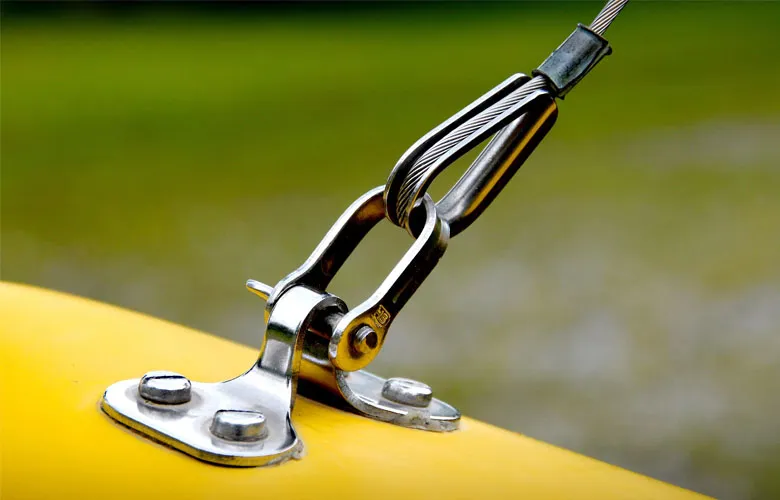
A shackle is a removable metal connector that joins ropes, chains, wire rope slings, and other hardware components. Traditional shackles have a U-shaped or rounded body with openings at both ends, secured by a removable pin.
Shackles are used in marine anchoring, boat rigging, towing connections, industrial equipment, and suitable lifting operations. Their simple construction allows users to assemble and separate components without permanently fastening them together.
Most traditional shackles have three essential elements:
Shackle body: The curved or D-shaped section that carries the applied force.
Shackle pin: The closing component that passes through the two ends of the body.
Pin retention system: A threaded connection, captive mechanism, or retaining bolt, nut, and cotter pin arrangement.
The shackle body and pin must work together as a complete assembly. Replacing a pin with an unsuitable component can affect performance and safety.
Why Does Shackle Design Matter?
Two shackles may have similar dimensions but very different intended uses.
A compact stainless steel shackle may be suitable for a boat fitting, while a rated alloy steel lifting shackle may be designed for industrial lifting operations. Their appearance alone does not establish their load capacity.
For this reason, buyers should consider the application, loading direction, material, and manufacturer’s specifications before selecting any rigging hardware.
2. What Are the Main Types of Shackles?
The different types of shackles can be grouped by body shape, pin mechanism, material, and purpose.
Understanding these classifications makes it easier to compare products without confusing a body design with a pin type.
Bow Shackles (Anchor Shackles)
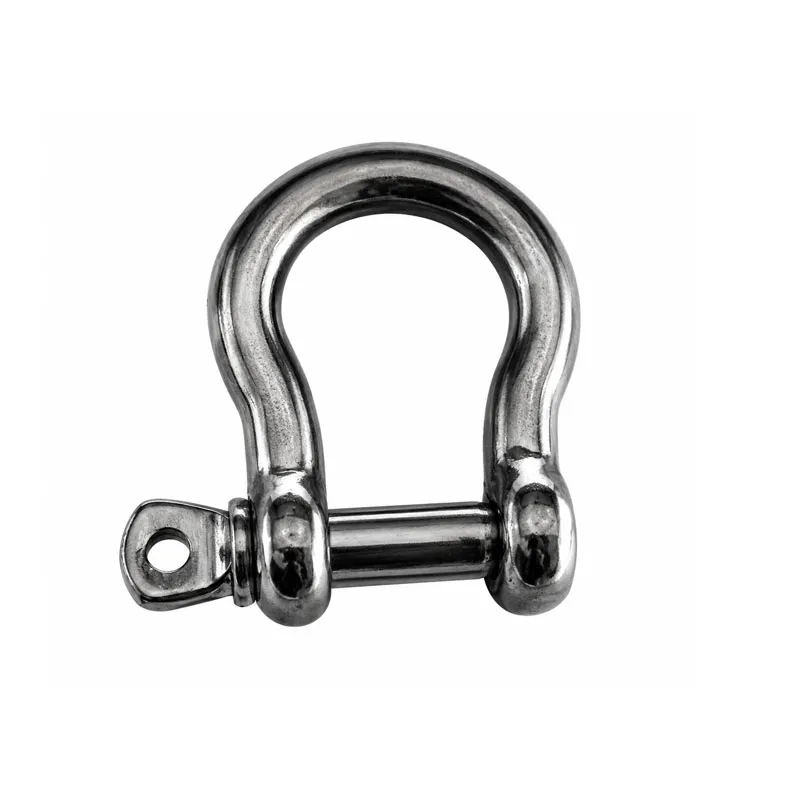
A bow shackle has a rounded body with a wider internal opening.
This shape provides more space for certain chain, rope, and sling connections. Bow shackles are commonly found in marine anchoring arrangements and industrial rigging systems.
In many catalogs, bow shackles are also called anchor shackles.
Their wider shape can accommodate some multiple-sling configurations when expressly permitted by the manufacturer. It does not mean that every bow shackle can safely carry side loads.
Dee Shackles (D Shackles or Chain Shackles)
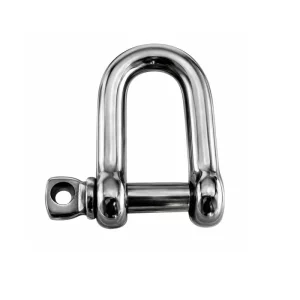
A dee shackle, sometimes called a D shackle or chain shackle, has a narrower, D-shaped profile.
It is commonly selected for straight-line connections involving chains, wire ropes, and suitable hardware fittings.
Because of its narrow design, a dee shackle is generally intended for loads aligned with the body’s centerline. It is not a universal solution for angled or multiple-sling loading.
Long Dee Shackles
Long dee shackles provide additional internal length compared with standard dee designs.
They are useful when an assembly requires greater clearance between connected components or a longer internal opening.
HIGRACE offers stainless steel long dee versions within its Euro shackle range.
Twisted Shackles
Twist shackles have a body geometry that changes the relative orientation of the connected components.
They are useful in selected marine hardware assemblies where connection points are positioned in different planes.
However, a twisted body does not automatically permit side loading or unrestricted movement.
Snap Shackles
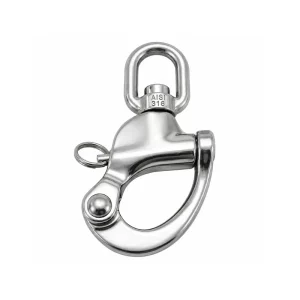
Snap shackles are quick-release connectors commonly used in sailing and marine rigging.
Instead of a conventional screw pin, they use a release mechanism that allows faster opening when operated according to the manufacturer’s instructions.
HIGRACE supplies fixed snap shackles, eye swivel snap shackles, and jaw swivel snap shackles for marine hardware applications.
High Tensile Shackles
High tensile shackles are designed with specified strength and load-bearing characteristics.
These products are commonly associated with industrial rigging, lifting, and towing equipment.
HIGRACE’s high tensile product series includes G-209, G-210, G-2130, and G-2150 models, with published dimensions and safe working load information.
Comparison of Common Shackle Designs
Shackle Design
Key Feature
Common Applications
Bow shackle
Wide rounded body
Marine connections, approved rigging assemblies
Dee shackle
Narrow D-shaped body
Straight-line chain and hardware connections
Long dee shackle
Extended internal length
Marine fittings requiring extra clearance
Twist shackle
Rotated body arrangement
Differently oriented connection points
Snap shackle
Quick-release mechanism
Sailing and marine equipment
High tensile shackle
Specified load-bearing performance
Rated lifting, towing, and industrial rigging
Buying tip: Start by identifying the required body shape, then select the material, pin arrangement, dimensions, and load rating appropriate for the intended use.
3. Bow Shackle vs. Dee Shackle: Which One Should You Choose?
The difference between a bow shackle and a dee shackle is one of the most important considerations in rigging hardware selection.
A bow shackle has a wider rounded body, while a dee shackle has a narrower and more elongated D-shaped profile.
Neither design is automatically better. Each serves different connection requirements.
When Should You Choose a Bow Shackle?
A bow shackle is often considered when an assembly requires a wider internal opening or a connection arrangement suitable for the specific rounded body geometry.
Typical applications include marine anchoring hardware, suitable rope connections, and manufacturer-approved sling assemblies.
However, side loading must be evaluated carefully. Any load-angle allowance or WLL reduction must come from the exact product’s instructions.
When Should You Choose a Dee Shackle?
A dee shackle is commonly preferred for a compact connection where the load follows a straight path through the body.
Typical applications include chain connections, marine fastening assemblies, and inline rigging connections.
A dee design should not be selected for multiple sling legs or lateral loading without explicit manufacturer approval.
Bow vs. Dee Shackle Comparison
Selection Factor
Bow Shackle
Dee Shackle
Body shape
Rounded
D-shaped
Internal space
Generally wider
Generally narrower
Main advantage
More connection room
Compact inline connection
Chain connections
Suitable when specified
Common for inline arrangements
Multiple sling connections
Possible with approved designs
Generally unsuitable unless approved
Side loading
Subject to manufacturer instructions
Subject to manufacturer instructions
HIGRACE offers both Euro Bow and Dee Shackles with Collar Pins, allowing marine hardware buyers to compare configurations and dimensions.
4.Stainless Steel vs. Galvanized Shackles: Which Is Better for Marine Use?
Material selection affects corrosion resistance, maintenance, appearance, and suitability for different environments.
AISI 316 stainless steel is widely selected for marine applications because of its resistance to many corrosive conditions.
It contains molybdenum, which improves resistance to certain chloride-related corrosion mechanisms compared with common 304 stainless steel.
HIGRACE offers AISI 316 stainless steel shackles in several marine product families.
Common buying applications include boat fittings, yacht rigging components, deck hardware, and coastal equipment.
However, stainless steel can still experience pitting, crevice corrosion, or other damage under unfavorable conditions.
AISI 304 Stainless Steel Shackles
AISI 304 is another commonly used stainless steel grade.
It can be appropriate for selected general hardware applications and less aggressive exposure conditions.
For equipment subject to frequent saltwater exposure, buyers should carefully compare 304 and 316 rather than assuming both grades perform equally.
Galvanized Carbon Steel Shackles
Galvanized shackles use a zinc coating to protect the underlying steel.
Hot-dip galvanized shackles are common in marine and industrial hardware markets.
HIGRACE lists carbon steel galvanized options in its Euro and US shackle ranges.
The corrosion performance depends on coating quality, environmental exposure, handling, and maintenance.
5.What Should Wholesale Buyers Look for in a Shackle Manufacturer?
For marine hardware distributors, rigging suppliers, and equipment manufacturers, choosing a supplier involves more than comparing unit prices.
Buyers also need suitable product specifications, dependable communication, documentation, and consistent quality across bulk orders.
Product Range and Material Options
A supplier with multiple shackle designs can help buyers source related products more efficiently.
HIGRACE offers stainless steel, galvanized, and high tensile options across several shackle series.
Its catalog includes marine fastening products and high tensile models with published load data.
This allows procurement teams to compare different configurations within one supplier’s range.
Manufacturing and Inspection Requirements
Before placing an order, buyers should confirm the requirements that apply to their intended market.
These may include material grade, dimensional tolerance, surface finish, mechanical tests, product markings, and inspection records.
If the products are intended for lifting, additional application-specific standards and documentation may be required.
Buyers should request evidence for the exact model rather than assuming every shackle from a supplier carries the same certification.
OEM and Custom Shackle Manufacturing
Standard shackles may not always match a buyer’s preferred design or existing equipment.
HIGRACE offers OEM services based on drawings or samples, along with material selection support, manufacturing development, and customized packaging.
These services can be valuable for international distributors, private-label marine hardware brands, and equipment manufacturers developing their own product lines.
FAQ
What are the most commonly used shackles?
Bow shackles and dee shackles are among the most commonly used body designs. Screw pin and bolt-type shackles are also widespread in suitable rigging applications. Marine equipment may additionally use captive pin, twist, and snap shackles.
What is the difference between a bow shackle and a chain shackle?
A bow shackle has a wider rounded body, while a chain shackle typically refers to a narrower dee-shaped design. Bow shackles provide more internal space for certain connections, whereas dee shackles are commonly selected for aligned chain and hardware connections.
Are screw pin shackles safe for overhead lifting?
Properly rated screw pin shackles may be used for overhead lifting when the manufacturer approves the application and all specified requirements are met. General-purpose or unrated marine screw pin shackles must not be assumed safe for lifting.
What is the advantage of a bolt-type shackle?
A bolt-type shackle uses secondary pin retention, commonly a nut and cotter pin. This makes it useful for certain long-term or critical connections, provided the product is suitable for the actual loading conditions.
Can HIGRACE manufacture custom shackles?
HIGRACE offers OEM manufacturing based on customer drawings and samples. Buyers can contact the company to discuss custom dimensions, materials, product development, and packaging requirements. Feasibility and any required testing must be confirmed for each project.

 English
 French
 Arabic
 Spanish


 November 02, 2026