Explore practical knowledge about marine hardware, rigging systems, anchoring and docking equipment, stainless steel materials, product selection, installation and maintenance.
Snap Hooks & Swivel Snaps: A Practical Guide to Snap Hardware for Marine Rigging
August 08, 2026
A snap hook may look simple, but the wrong gate, swivel, material, or connection size can create poor fit, fast wear, and costly sourcing problems. For marine buyers, the safest approach is to choose snap hardware according to the actual rig, environment, attachment method, and required performance.
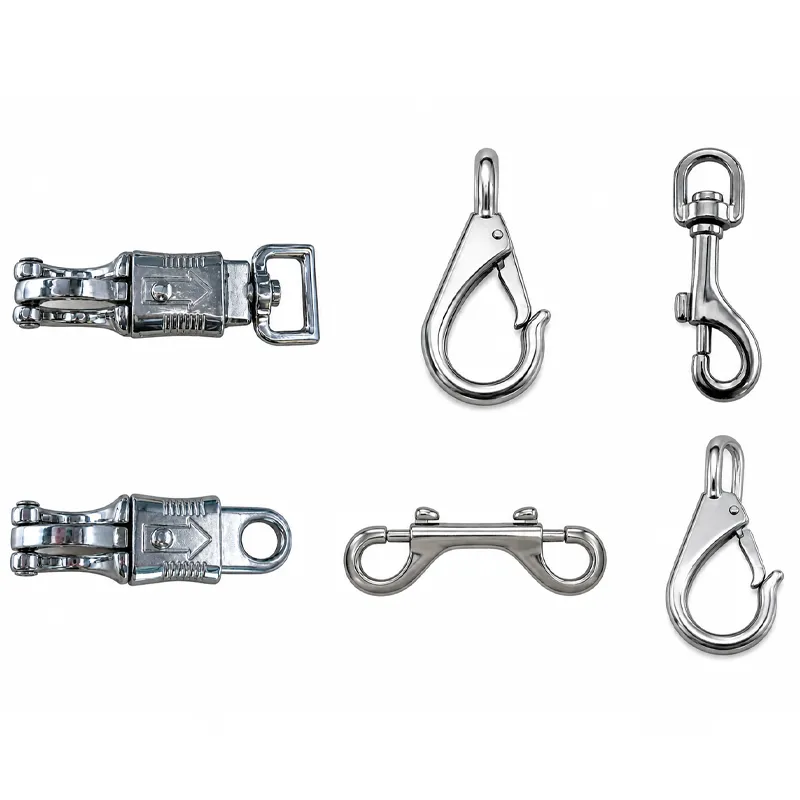
A snap hookis a quick-connect fitting that uses a spring-loaded gate or trigger mechanism to connect rope, straps, chains, or other hardware. Marine buyers should choose between standard snap hooks, swivel snaps, trigger snaps, bolt snaps, and related hooks based on material, connection type, size, corrosion resistance, movement, and the requirements of the complete rigging system.
What Is a Snap Hook and How Does Snap Hardware Work?
A snap hook is a quick attachment fitting with a gate, latch, or lever that opens to receive another component and then closes automatically or manually. The basic idea is simple: connect two parts quickly without removing a pin or completely opening a threaded connection.
Most snap designs use a spring-loaded mechanism. You press the gate or trigger, connect the fitting, and release it. The spring returns the gate to its closed position. This makes a snap useful where equipment needs to be connected and disconnected often.
Common parts may include:
Hook body
Spring gate
Trigger or lever
Eye or swivel
Attachment point
Spring
Latch
Connecting pin
A snap clip may be used to describe several compact quick-connect designs, while more specific names such as bolt snap, trigger snap, spring snap, and swivel snap describe how the fitting is built or how it moves.
For B2B buyers, naming matters. Two products may both be called a snap hook yet have very different bodies, gates, eye shapes, materials, and applications.
HIGRACE supplies marine and rigging hardware as part of a broader product portfolio covering Anchoring & Docking, Deck Hardware, and Rigging & Sail Control. Buyers sourcing snap hooks can therefore match them with related marine shackles and connection hardware, turnbuckles, wire rope fittings, blocks, and other components.
What Are the Main Types of Snap Hooks?
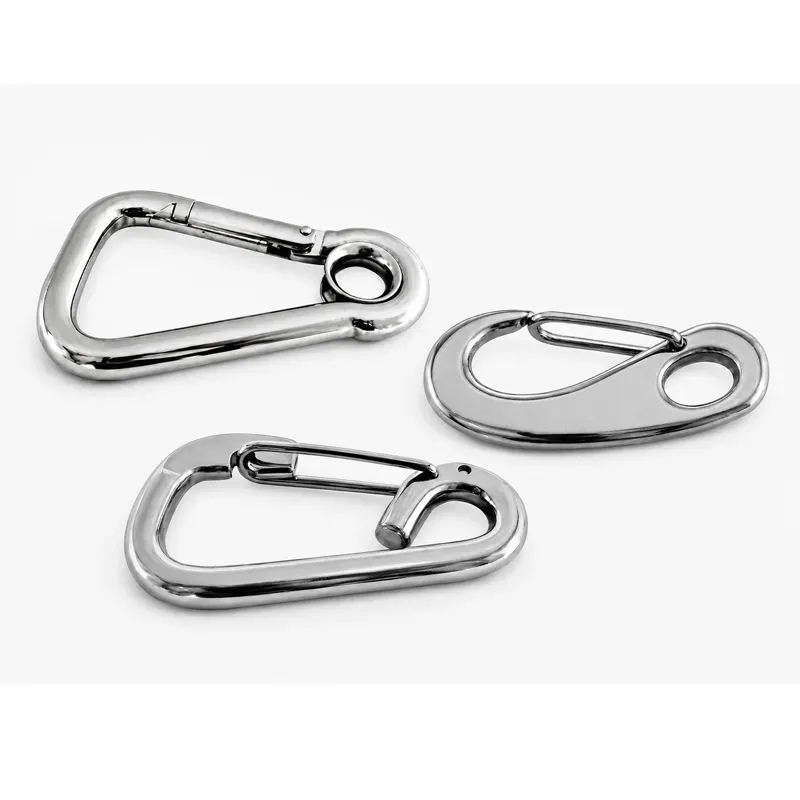
There is no single type of snap hook for every application. The design determines how the fitting connects, whether it can rotate, and how quickly the gate can be opened.
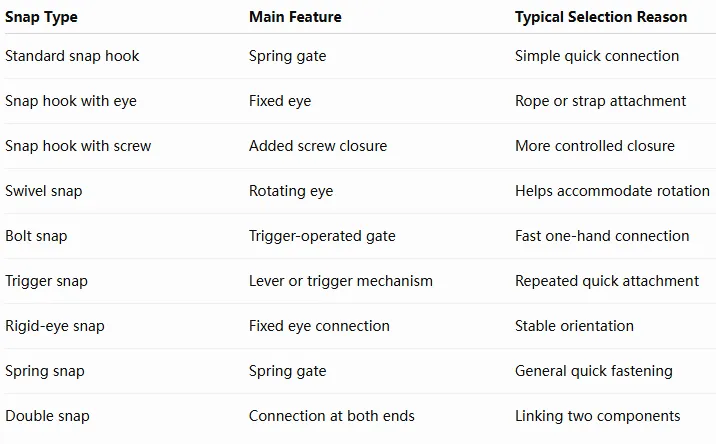
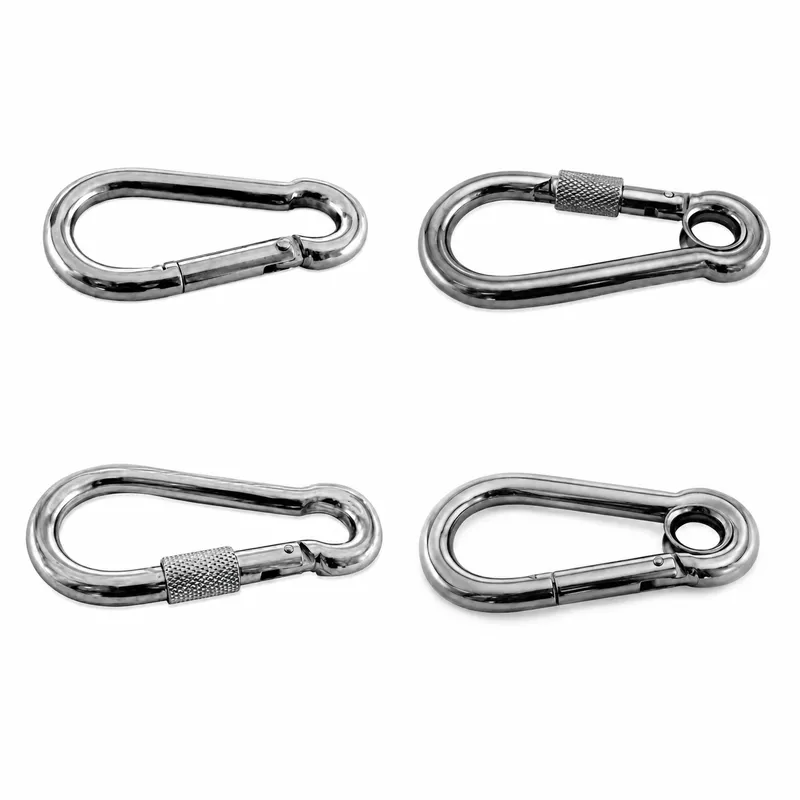
Typical snap categories include:
A spring snap hook usually relies on a gate that springs back into place. A trigger design uses a more pronounced trigger mechanism. A swivel snap hook adds rotational movement at the eye.
A marine distributor may stock several versions because buyers often need different combinations of gate design, eye type, total length, and material.
Some markets also use terms such as classic swivel, gate snaps, spring hooks, or swivel spring snap. These terms can overlap. For technical purchasing, product drawings and dimensional data are more reliable than the product name alone.
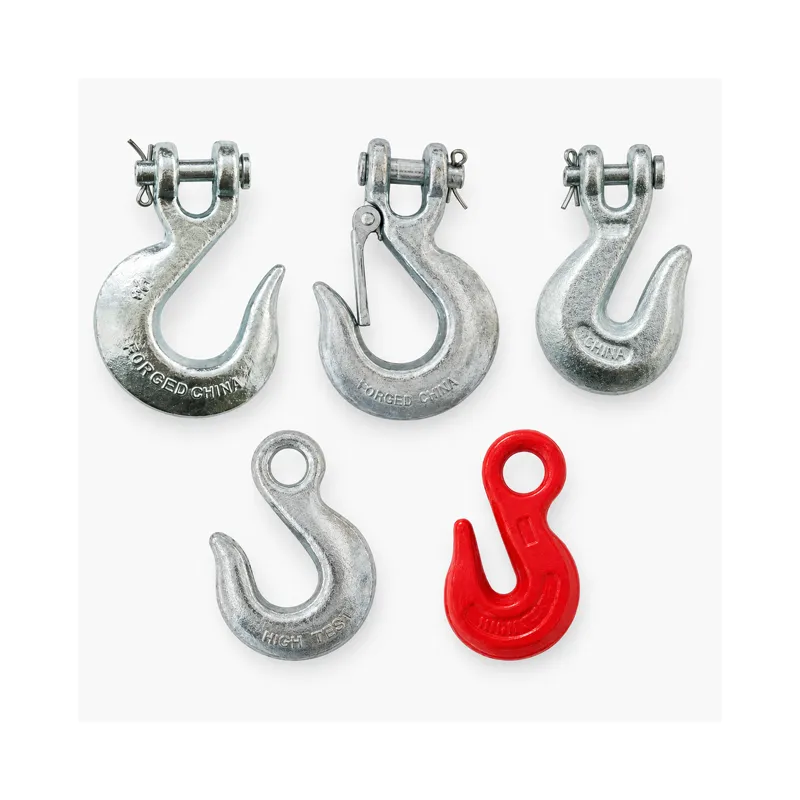
Explore HIGRACE’s Snaps & Hooks product range when building a product selection around different connection styles.
When Should You Choose a Swivel Snap Hook?
A swivel snap combines a quick-opening hook with a rotating connection point. That rotation can be useful when the connected rope, strap, or cable may turn during use.
For example, if a fixed snap connects a flexible line to another fitting, repeated movement can twist the line. A metal swivel at the base of the hook allows part of that rotation to occur within the fitting rather than being transferred completely into the connected component.
Common versions include:
Swivel bolt snap
Swivel eye snap
Swivel eye bolt snap
Swivel trigger snap
Swivel spring snap
The important point is not simply that the hook swivels. Buyers must also check the eye geometry and the component attached to that eye.
A round eye may receive rope or another connector. A more specific eye may be designed for a strap or fixed attachment. The swivel itself should also rotate smoothly without excessive looseness.
In a marine rig, controlled movement can make installation cleaner and reduce unnecessary twisting. Still, a swivel does not automatically make a hook suitable for every load-bearing application. The actual model specification must define its intended use.
How Do Spring Snap Hooks, Bolt Snaps, and Trigger Snaps Differ?
These names often sound interchangeable, but the mechanisms can differ.
A spring snap typically has a gate that opens inward or sideways against spring pressure. Release the gate and the durable spring returns it to the closed position.
A bolt snap usually uses a sliding bolt-like section operated by a small lever. A trigger snap may use a larger trigger or lever that retracts the gate. The design gives fast access when the user needs repeated opening and closing.
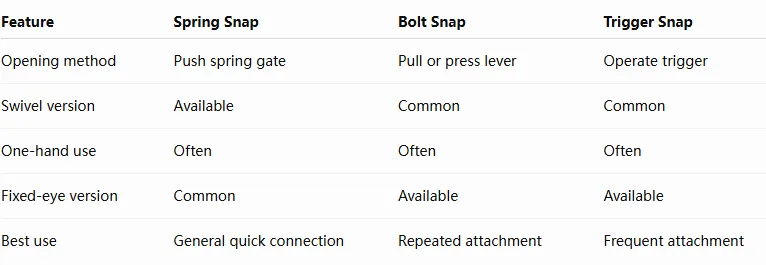
A typical selection comparison looks like this:
Trigger snap hooks are often selected when easy operation matters. A bolt snap can provide similarly convenient connection, while a spring snap hook may offer a simpler structure.
You may also see terms such as panic snap or bull snap in broader hardware markets. These are different specialized designs and should not be treated as direct substitutes simply because they use a spring or quick-release principle.
The lesson for procurement teams is straightforward: buy from drawings and specifications, not keyword labels alone.
Which Materials Are Suitable for Marine Snap Hardware?
Material is especially important for marine products because water, salt, humidity, and outdoor exposure can accelerate corrosion.
HIGRACE’s broader marine hardware program uses AISI 316 stainless steel as a key material, with carbon steel, galvanized steel, and other options depending on the product. For snap hooks, the correct material should always be confirmed at the individual model level.
Stainless Steel
Stainless steel is widely used for marine fittings because it provides good resistance to corrosion and a clean surface finish.
AISI 316 is particularly important in marine hardware sourcing because it is commonly selected for components exposed to wet or salt-rich environments.
Galvanized Steel
Galvanized finishes can provide another practical option for selected hardware. Buyers should distinguish between electro-galvanized and hot-dip galvanized finishes rather than using only the word “zinc.”
Other Market Materials
Broader snap markets may include:
Brass
Nickel-plated metal
Zinc alloy
Aluminum alloy
Die-cast components
These materials can appear in searches for brass snap hooks, nickel hardware, zinc fittings, or die cast snaps. However, those search terms do not mean every marine supplier offers every material.
For HIGRACE sourcing, confirm the material and finish of the specific model before placing an order.
Where Are Snap Hooks Used on Boats and in Marine Rigging?
On a boat, snap hookscan support many connection tasks where fast access is useful.
Depending on the model and application, snaps may be incorporated into rope systems, straps, accessory attachments, covers, light-duty securing arrangements, and selected rigging assemblies.
Typical marine-related uses can include:
Rope attachment
Strap fastening
Accessory connection
Boat-cover hardware
Sail-control accessories
Detachable lines
Deck accessory connections
Selected rigging connections
Lanyard attachment
Safety accessory systems where the specific fitting is approved
A swivel snap can be useful where the line tends to rotate. A fixed-eye snap may be preferable when orientation needs to remain stable.
This is also where related products matter. A snap may connect to a ring, shackle, rope eye, chain link, or another piece of snap hardware.
HIGRACE’s broad product coverage helps professional buyers source connected categories together. Snaps and hooks can be paired with links, rings, bolts and nuts, clips, thimbles and swivels, and other marine connection products.
A Simple Marine Connection Example
Consider a distributor building a marine accessory range.
The buyer may need:
A stainless snap hook
A swivel version for rotating attachments
A round ring
A shackle
Rope fittings
Custom retail packaging
Buying these parts from separate vendors increases the number of drawings, samples, purchase orders, inspections, and packaging discussions.
Consolidating related components can make product matching and purchasing more efficient.
What Should Distributors Check Before Buying Snap Hooks in Bulk?
The biggest B2B mistake is treating snap hooks as commodity items based only on price.
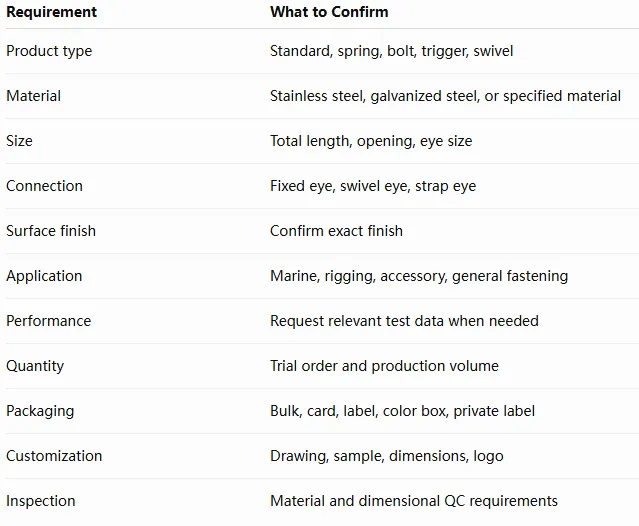
Before ordering, prepare a specification sheet.
Snap Hook Procurement Checklist
For a professional distributor, consistency between batches is important. A product that changes slightly in gate shape, spring feel, eye dimensions, or surface finish can create problems when it must fit existing accessories.
Quality control therefore matters.
HIGRACE supports quality inspection and can provide QC-related services such as material verification and other inspection activities according to project requirements.
Our engineering support is also useful when a buyer needs a modified body, eye, attachment structure, or entirely new component based on a drawing or sample.
How Do You Decide Whether a Snap Is Suitable for Load-Bearing Use?
This deserves special attention.
A snap hook may look strong, but appearance does not prove its load capacity.
Terms such as:
Heavy duty
Heavy-duty spring
High-grade
Durable
Strength and durability
are not replacements for technical data.
If the snap will be used in a load-bearing rig, lifting sling, high-tension connection, safety system, or other critical application, confirm the exact model’s documented performance and required safety factors.
Do not assume that every stainless snap is suitable for lifting.
Likewise, a snap used to secure straps or accessories may have very different requirements from one used in industrial applications.
For sourcing purposes, ask for:
Material specification
Product dimensions
Breaking-load data where applicable
Working-load information where supplied
Inspection method
Test report availability
Intended application
Relevant standard or customer specification
This is one reason professional buyers should work with manufacturers that understand both product development and QC rather than relying only on marketplace photographs.
Why Source Snap Hooks and Related Rigging Hardware from HIGRACE?
HIGRACEHardware Limited has served international B2B markets since 2006, focusing on marine hardware, rigging hardware, and precision stainless steel investment casting.
Our product portfolio is not limited to one snap.
We supply connected categories across three major marine application areas:
For distributors and wholesalers, this product breadth can reduce the need to manage many separate suppliers.
HIGRACE also supports OEMand custom manufacturing based on drawings or samples. If a standard snap does not fit your market, our team can discuss modifications to dimensions, connection style, material, or other design requirements.
Our manufacturing capabilities include precision stainless steel investment casting, also known as lost-wax casting, together with other manufacturing methods suited to different components.
We also support:
New product development
Engineering assistance
Quality inspection
Customized packaging
Private-label programs
Multi-category sourcing
For private-label distributors, packaging can be coordinated together with the product instead of being treated as a separate sourcing project.
This creates a more complete purchasing path: select the snap → match related hardware → confirm material → inspect the product → customize packaging → consolidate sourcing.
Explore HIGRACE’s broader Rigging & Sail Control solutions if your sourcing program also includes shackles, turnbuckles, wire rope fittings, or blocks.
How Can OEM Snap Hook Development Help a Marine Brand?
Standard products work for many applications, but not every customer wants the same hook.
At HIGRACE, we can review a customer’s drawing, sample, dimensional requirement, intended use, and target market before discussing manufacturing.
For a new snap product, a useful RFQ should include:
Product drawing or reference sample
Material requirement
Key dimensions
Gate or trigger design
Fixed or swivel connection
Intended application
Target quantity
Test requirements
Packaging requirement
Branding or private-label needs
The clearer the RFQ, the faster both sides can identify what needs to be confirmed.
If you are developing a new marine snap or expanding an existing catalog, contact HIGRACE for OEM marine hardware development with your drawing, sample, or product list.

 English
 French
 Arabic
 Spanish



 August 08, 2026