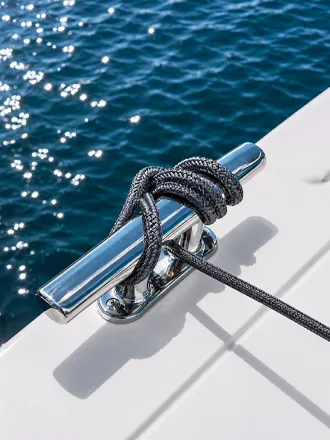
Explore practical knowledge about marine hardware, rigging systems, anchoring and docking equipment, stainless steel materials, product selection, installation and maintenance.
316 vs 304 Stainless Steel for Marine Hardware: Which Is Better for Boats and Marine Applications?
August 08, 2026
Choosing the wrong stainless steel for marine hardware can lead to early corrosion, higher maintenance costs, and unhappy customers. The challenge is that 304 and 316 stainless steel can look almost identical. Understanding where each grade fits helps boat builders, distributors, and marine hardware buyers make a better sourcing decision.
For most saltwater marine hardware, AISI 316 stainless steel is generally preferred because it offers better resistance to chloride-related corrosion than AISI 304. However, 304 stainless steel can still be suitable for selected freshwater, indoor, or less aggressive environments. The right choice depends on exposure, product design, maintenance, cost, and the specific application.
Why Does Stainless Steel Grade Matter for Marine Hardware?
Marine hardware works in a difficult environment.
Anchors, shackles, cleats, turnbuckles, rail fittings, deck fittings, snap hooks, hinges, and other parts may face salt spray, moisture, rain, temperature changes, and repeated mechanical contact. Even hardware that does not stay underwater can remain wet for long periods.
That makes material selection an important part of marine hardware sourcing.
For professional buyers, the question is not simply:
“Is this product stainless steel?”
A better question is:
“Which stainless steel grade is used, and is it suitable for this application?”
Two fittings can look almost the same but perform differently after long-term exposure.
This matters especially for:
Boat builders
Yacht manufacturers
Marine hardware distributors
Marine equipment importers
Rigging suppliers
Chandlery wholesalers
Private-label marine hardware brands
When these companies select a product, they are also protecting their own reputation in the market.
What Is AISI 304 Stainless Steel?
AISI 304 is one of the most widely used stainless steel grades in industrial and consumer products.
It offers good corrosion resistance in many normal environments and is commonly used for machinery, fabrication, household equipment, architectural products, and selected marine components.
Its main advantages include:
Good general corrosion resistance
Good formability
Good appearance
Wide availability
Suitable performance in many non-aggressive environments
Usually lower material cost than 316
For some boat accessories and hardware used in freshwater, protected areas, cabins, or low-salt environments, AISI 304 stainless steel can be a practical choice.
However, marine conditions are not always mild.
Saltwater contains chlorides, and chloride exposure can increase the risk of localized corrosion. This is where 316 becomes especially important.
What Is AISI 316 Stainless Steel?
AISI 316 stainless steel is widely associated with marine-grade stainless steel because it provides improved corrosion resistance in chloride-containing environments.
Compared with 304, its alloy composition includes molybdenum, which helps improve resistance to pitting and crevice corrosion.
For this reason, 316 is commonly selected for products exposed to:
Saltwater
Coastal air
Sea spray
High humidity
Outdoor marine environments
Repeated wet and dry cycles
Typical 316 stainless steel marine hardware may include:
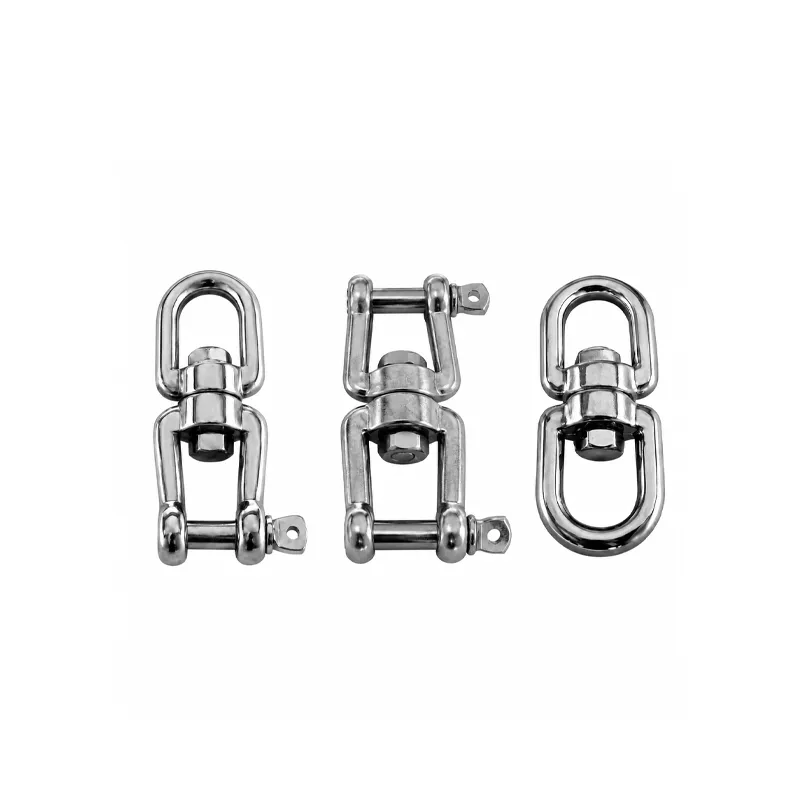
Shackles
Snap hooks
Swivels
Thimbles
Turnbuckles
Rigging screws
Terminals
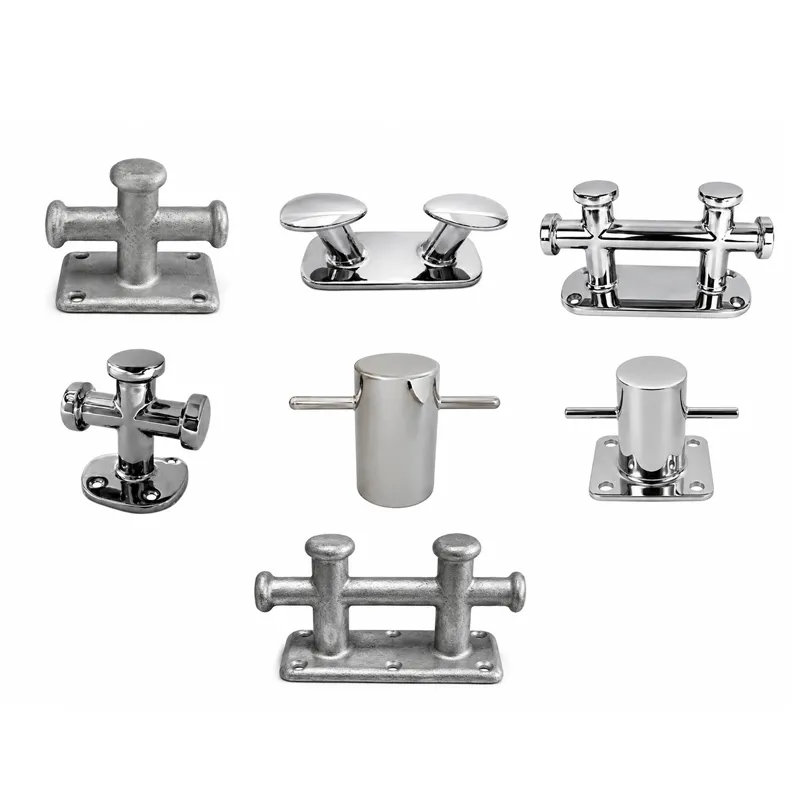
Cleats
Bollards
Rail fittings
Deck hinges
Deck fillers
Thru-hulls
Bow rollers
Anchor connectors
Selected blocks and pulleys
At HIGRACE, AISI 316 stainless steel is an important material across many of our marine and rigging hardware categories.
However, we do not recommend assuming that every marine product must automatically be made from 316.
Application still comes first.
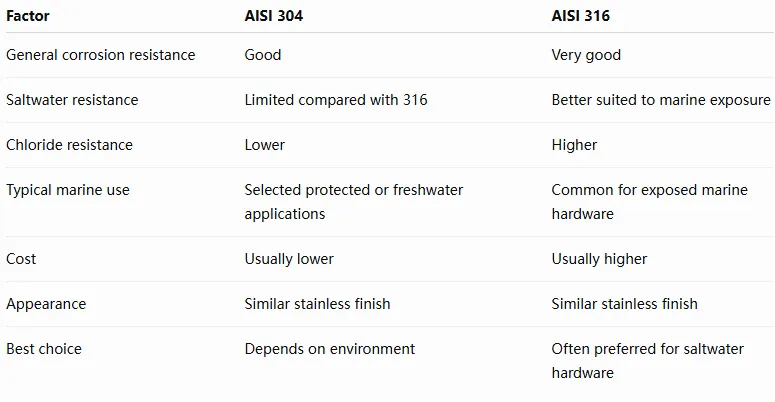
304 vs 316 Stainless Steel: What Is the Main Difference?
For marine buyers, the most important practical difference is corrosion performance.
The important point is that 304 and 316 are not visually easy to distinguish.
A buyer cannot reliably confirm material grade simply by looking at a polished fitting.
This is why material documentation and quality control matter in B2B sourcing.
For distributors importing large quantities of stainless steel boat hardware, a small material mistake can affect an entire batch.
Is 316 Stainless Steel Always the Best Choice for Boat Hardware?
Not necessarily.
316 offers strong advantages in saltwater conditions, but the best material depends on the actual product and operating environment.
Consider these examples.
Saltwater Yacht Rigging
A sailboat used regularly in coastal or offshore conditions is exposed to salt, spray, humidity, and repeated outdoor use.
Here, 316 stainless steel rigging hardware is often a logical choice for products such as turnbuckles, terminals, shackles, swivels, and related fittings.
Freshwater Boat
A boat used only on freshwater lakes may face a less aggressive corrosion environment.
Some 304 stainless steel products may perform well depending on the component and maintenance conditions.
Hidden or Interior Hardware
Hardware installed inside cabins or other protected areas may not require the same corrosion resistance as fittings mounted directly on deck.
Heavy Chain or Anchor Applications
Stainless steel is not the only option.
Certain anchors, chains, hooks, and other products may use carbon steel with hot-dip galvanized finishes depending on design, application, and market requirements.
The key sourcing principle is simple:
Do not select materials based only on the word “marine.” Select them according to the real operating conditions.
Which Marine Hardware Products Benefit Most from AISI 316?
Products with frequent exposure to saltwater or sea air usually receive the greatest benefit.
Shackles and Snap Hooks
Marine shackles and snap hooks may connect rope, chain, rigging assemblies, or deck accessories.
When these components stay outdoors, corrosion resistance becomes important.
HIGRACE supplies different types of marine connection hardware, including:
Dee shackles
Bow shackles
Long Dee shackles
Twisted shackles
Snap shackles
Snap hooks
Swivel snaps
Quick links
Rings
AISI 316 is available for many stainless steel models depending on product type.
Rigging Hardware
Sailboat rigging frequently uses stainless steel because appearance, strength, dimensional stability, and corrosion resistance all matter.
Examples include:
Rigging screws
Turnbuckles
Swage terminals
Eye terminals
Jaw terminals
Pelican hooks
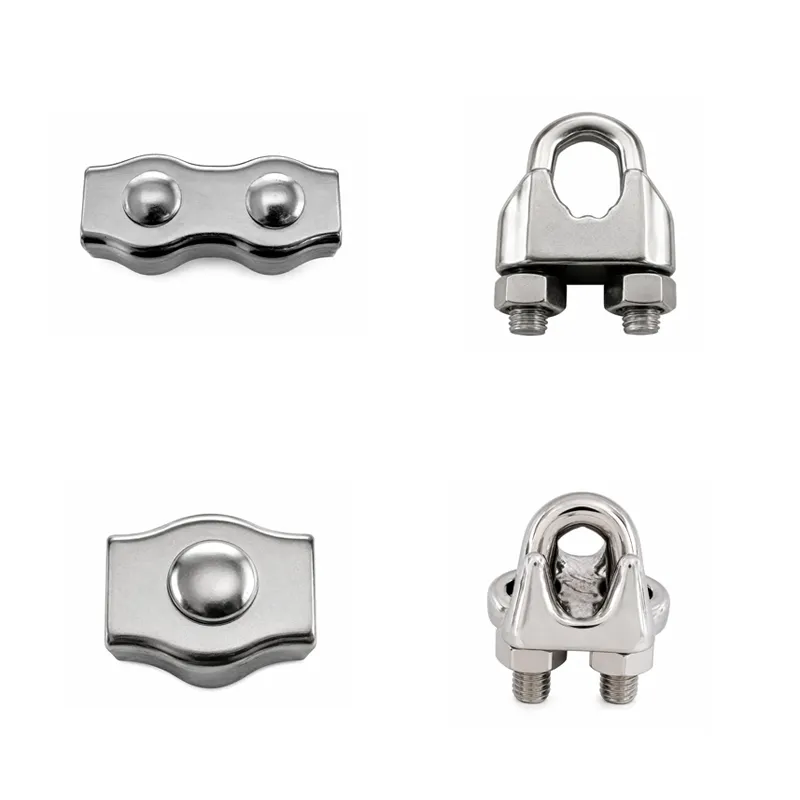
Wire rope fittings
These products form part of HIGRACE’s Rigging & Sail Control hardware range.
Rail Fittings
Boat rails are constantly exposed to the outdoor environment.
Marine rail hardware can include:
Top caps
Top slides
Tees
Elbows
Stanchions
Bases
Handrail fittings
A polished AISI 316 finish also helps maintain the clean appearance expected on yachts and recreational boats.
Deck Fittings
Deck hardware may remain exposed throughout the life of the vessel.
Common products include:
Deck hinges
Hasps
Lifting rings
Deck fillers
Thru-hulls
Intake strainers
Vents
For these products, material selection should consider exposure, installation position, mating materials, and maintenance.
How Can Distributors Avoid Material Problems When Importing Marine Hardware?
The first step is creating a clear RFQ.
Instead of sending:
“Please quote 316 marine hardware.”
Send detailed information such as:
Product name
Product drawing
Required material grade
Size
Surface finish
Quantity
Application
Packaging requirement
Inspection requirement
Target market
A more complete RFQ reduces misunderstandings.
Why Does Manufacturing Process Matter for Stainless Steel Marine Hardware?
Material is important, but manufacturing method also affects the final product.
HIGRACE specializes in precision stainless steel investment casting, also known as lost-wax casting, for marine and industrial hardware.
This process is useful for many stainless steel parts with complex shapes.
Our wider product-development capabilities also include manufacturing processes such as:
Lost-wax casting
Forging
Stamping
Die casting
CNC machining
Different products require different processes.
A stainless steel deck hinge may not follow the same manufacturing route as a forged hook. A turnbuckle component may require machining, while another fitting may be investment cast.
For OEM buyers, this matters because a supplier should choose the process according to the product design rather than force every design into the same production method.
Why Work with HIGRACE for Stainless Steel Marine Hardware?
HIGRACE Hardware Limited has focused on marine hardware, rigging hardware, and stainless steel precision casting since 2006.
Our marine product portfolio covers three major application groups:
Anchoring & Docking
Including products such as:
Anchors
Chains
Cleats
Bollards
Anchor connectors
Bow rollers
Mooring hardware
Deck Hardware
Including:
Deck hinges
Hasps
Rail fittings
Deck fillers
Thru-hulls
Vents
Boat accessories
Rigging & Sail Control
Including:
Shackles
Snap hooks
Clips
Thimbles
Swivels
Turnbuckles
Terminals
Blocks and pulleys
For distributors, boat builders, yacht manufacturers, importers, and marine hardware brands, this broad range can reduce the need to manage many separate suppliers.
We also support:
OEM manufacturing
Drawing-based customization
Sample-based development
Engineering support
New product development
Material inspection
Mechanical testing
Customized packaging
Private-label projects
This combination is useful when your business needs more than one stainless steel fitting.
Instead of sourcing shackles from one supplier, turnbuckles from another, and deck fittings from a third, you can discuss a more complete marine hardware purchasing program with one manufacturing partner.

 English
 French
 Arabic
 Spanish


 August 08, 2026